
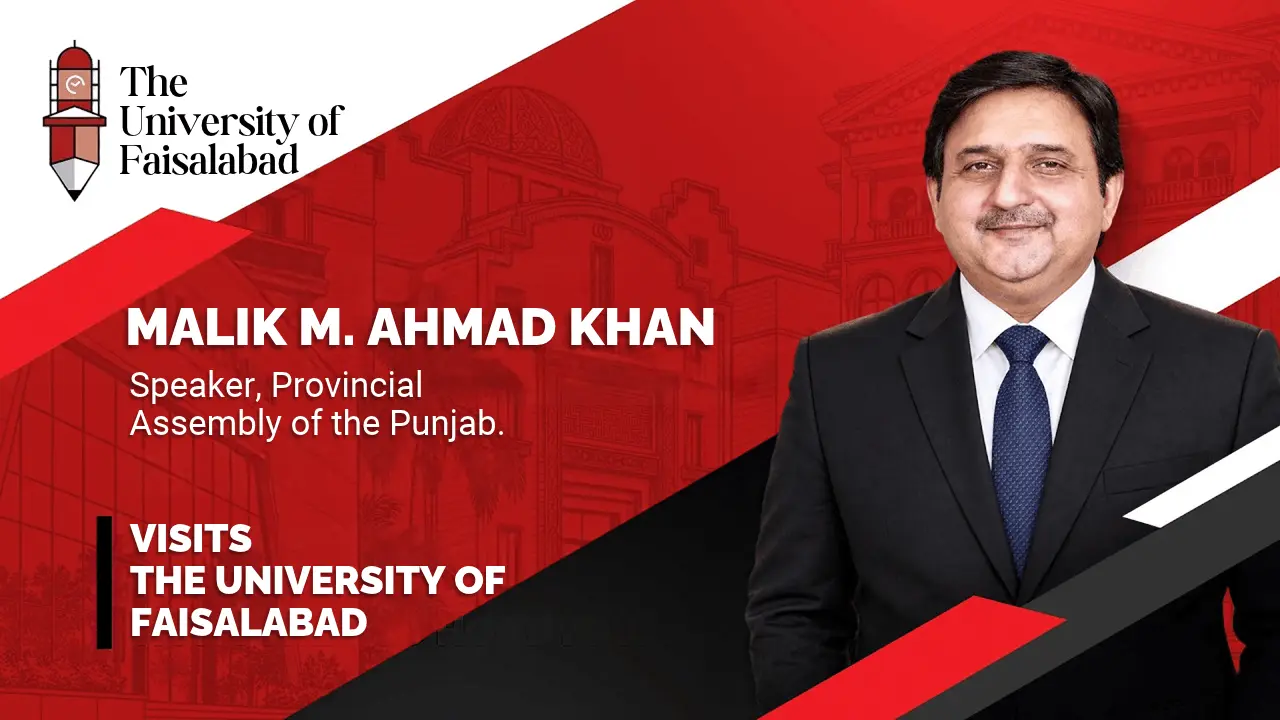
Malik Muhammad Ahmad Khan, Speaker of the Provincial Assembly of the Punjab, Visits TUF for Interactive Session on Good Governance
Good governance, inclusive policymaking and institutional accountability took center stage as Speaker of the Provincial Assembly of the Punjab, Malik Muhammad Ahmad Khan, led an interactive session on “Good Governance: Inclusion, Diversity and Institutional Effectiveness” at The University of Faisalabad.
The session provided a platform for political and academic discourse on democratic governance, constitutional values, institutional responsibility and the importance of inclusive participation in strengthening Pakistan's administrative and democratic framework.
Upon his arrival, Malik Muhammad Ahmad Khan was warmly received by Mian Muhammad Hanif, Patron-in-Chief, TUF; Dr Muhammad Haider Amin, Chairman, Board of Governors; Prof Dr Aman Ullah Malik, Rector; and Dr Zahida Maqbool, Registrar, along with heads of departments, faculty members and students. Chaudhry Zaheer-ud-Din Khan, former Member of the Provincial Assembly Punjab, also graced the occasion.
In his welcome address, Prof Dr Aman Ullah Malik expressed appreciation for the distinguished guest's presence and highlighted the significance of engaging students in discussions on constitutional governance, democratic values and institutional responsibility.
Chief Guest Malik Muhammad Ahmad Khan emphasized that good governance must be measured by the extent to which citizens enjoy their fundamental rights, including access to education, healthcare, justice and the rule of law, stressing that the country's growing security and institutional challenges demand an accountable and effective governance system.
He described good governance as a multidimensional concept, stating that “good governance is a story of so many chapters,” encompassing merit, fairness, transparency, accountability and the effective functioning of democratic institutions.
Referring to the challenges confronting Pakistan, Malik Muhammad Ahmad Khan highlighted the prevailing security situation, including conflicts along the country's borders and threats to essential public infrastructure, particularly educational and healthcare institutions. He maintained that addressing such challenges required sound governance, institutional coordination and policies that safeguarded the rights and welfare of citizens.
Expressing concern over the state of education, he drew attention to the large number of out-of-school children and the alarming dropout rates at different stages of schooling. He cited figures indicating that nearly 40 per cent of students drop out of the education system, while 50 per cent fail to progress beyond middle school and a substantial proportion are unable to continue their education at the higher secondary level. He underscored the need for educational reforms to ensure equitable access, continuity of learning and improved opportunities for the younger generation.
Elaborating on the fundamental principles of good governance, he identified merit as its foremost requirement, emphasizing that public institutions must operate through predictable, transparent and established systems rather than individual discretion. Fairness, transparency and accountability, he observed, were equally essential to building public confidence and ensuring effective institutional performance.
He also reflected on the historical foundations of Pakistan's administrative structures, pointing to the persistence of colonial-era governance practices and the need to modernize institutions in line with contemporary democratic requirements.
Addressing the role of emerging technologies in education, he encouraged students to develop independent judgment and critical thinking, emphasizing that artificial intelligence should serve as a supporting tool rather than a substitute for intellectual inquiry and analytical reasoning.
Malik Muhammad Ahmad Khan also paid tribute to Mian Muhammad Hanif (SI), Patron-in-Chief of TUF, commending his vision and contributions to the institution's development. He remarked that The University of Faisalabad had emerged as a center of excellence, reflecting the sustained efforts made towards advancing higher education.
He expressed gratitude to Dr Muhammad Haider Amin, Chairman, Board of Governors, TUF, for extending the invitation and according him the honour of addressing the TUF community.
The address was followed by an interactive question-and-answer session, during which Malik Muhammad Ahmad Khan responded to questions raised by TUF students on governance, democratic institutions and contemporary national challenges.
Concluding the proceedings, Mr Muhammad Haider Amin presented the vote of thanks, acknowledging the valuable insights shared by Malik Muhammad Ahmad Khan and appreciating his engagement with the university's academic community.